


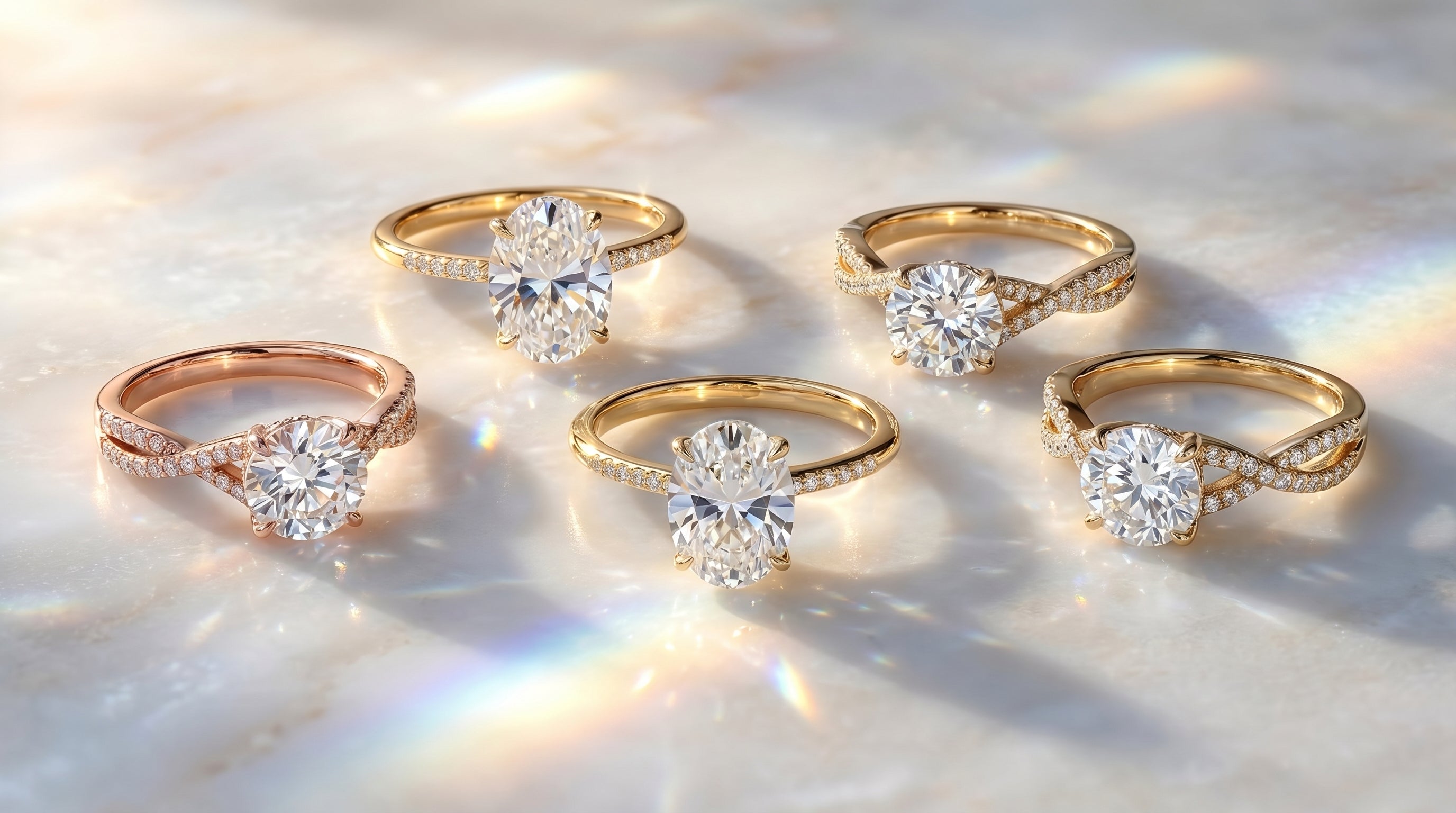
Turn an 18k gold engagement ring toward the light and look inside the band. If it is genuinely 18 karat, you should find a small stamp reading 750 or 18K. That number is not decoration — it is a purity declaration: 750 parts pure gold per thousand, or 75% fine gold blended with 25% alloy metals such as copper, silver, zinc, palladium, or nickel. Everything that matters about an 18k ring — its color depth, its skin friendliness, its resistance to bending, and a measurable share of its price — flows from that 75/25 ratio. This guide walks through what that composition actually buys you, how to calculate the gold value per gram before you shop, how to tell solid 18k from plated look-alikes, and how to allocate a budget between metal, setting, and center stone.
What "18k" Actually Means Inside the Band
Karat measures purity, not weight or size. At 18 karat, three quarters of the metal is pure gold; the remaining quarter is alloy that supplies hardness and, in the case of white and rose gold, color. Jewelers often describe 18k as the sweet spot between maximum gold content and the strength a ring needs to survive being worn every day, and that framing is fair: it holds the rich, warm tone associated with fine gold while remaining workable enough for prongs, pavé, and detailed gallery work.
Hallmark conventions vary by country. In the United States you will typically see the karat designation (18K, 18KT) or the numeric equivalent 750. Elsewhere, national assay systems use recognized symbols — France's eagle's head mark, for example, certifies 18-carat gold. Knowing that formats differ internationally is useful if you are buying from an overseas retailer or considering an antique piece, because the absence of a familiar "750" does not automatically mean the metal is suspect, and an unfamiliar-looking mark is worth researching before you dismiss or trust it.
Yellow, white, and rose: same purity, different alloys
All three colors can be made at 18k, because the gold content stays fixed and only the alloy recipe changes. Yellow 18k gold shows the deep, warm hue most people associate with fine jewelry — noticeably richer than 14k because it carries roughly 15% more pure gold. White gold is alloyed to a pale, neutral tone and then typically finished with rhodium plating to reach the bright white shoppers expect. Rose gold gets its pink cast from copper, sometimes with silver in the mix, and has built a durable following rather than a passing one.
Alloy choice and sensitive skin
Because 18k contains fewer alloy metals than lower karatages, it carries a lower allergen load overall. But the specific alloy still matters. Nickel is a common and inexpensive alloying metal, and it is also one of the most frequent causes of contact dermatitis — research cited in this brief puts the affected share of the population at roughly 10–15%. Better 18k jewelry favors noble metals such as silver and palladium instead. If you or your partner have reacted to earrings, watch backs, or belt buckles in the past, ask what the 25% actually consists of before you buy, and ask whether the maker can supply a test band in the same alloy.
18k Versus 14k, 22k, 24k, and Platinum
Karat comparisons are usually presented as "purer is better," which is misleading for a ring worn daily.
Against lower and higher karats
14k gold is 58.5% pure. It is harder and more scratch-resistant thanks to its higher alloy content, but it trades away some of the saturated color of high-gold alloys. At the other end, 24k is 99.9% pure and far too soft and malleable for a ring in constant contact with desks, steering wheels, and gym equipment — it bends and marks easily. 22k, at 91.7%, sits closer to pure gold and suits plain bands better than an engagement ring that must hold a stone securely in prongs. Against that spectrum, 18k gives you high gold content without asking the metal to do work it cannot do.
Yes, 18k is softer than 14k. In practice this is a lifestyle question rather than a durability disqualifier: the 25% alloy supplies adequate resilience for ordinary daily wear, and the sensible adaptation is to remove the ring for weightlifting, gardening, construction work, or anything abrasive. Many shoppers rule out 18k over this single point when a simple habit resolves it.
Against platinum
Platinum is denser and harder, and platinum prongs are markedly less likely to break than gold prongs over decades — a genuine advantage for protecting an expensive center stone. The costs are twofold. Platinum's reduced malleability demands more skilled labor and longer fabrication time, and its density means a ring needs more metal mass to reach the same dimensions. Even where per-gram pricing between the two metals has converged, platinum rings therefore land higher overall. Platinum also needs no plating to stay white, whereas white gold needs periodic rhodium renewal. If you want warm yellow or rose tones, platinum simply cannot deliver them; if you have an unusually hard-wearing occupation and want a white metal, platinum's hardness may justify the premium.
How an 18k Gold Engagement Ring Is Priced
Two very different questions get asked here: what the gold in the ring is worth, and what the ring costs. They are not the same number, and confusing them causes most sticker shock.
Working out the gold value per gram yourself
The arithmetic is simple and you can do it on your phone in the store. Look up the current spot price of gold per gram on the day you are shopping, then multiply by 0.75, because only 75% of an 18k piece is fine gold. That gives the raw gold value of one gram of 18k. Multiply by the ring's weight to get the metal's intrinsic value.
So a 2-gram 18k ring contains 1.5 grams of pure gold plus 0.5 grams of alloy. That is the honest floor of its material value — and it explains why a delicate 2-gram band and a heavy signet-style ring in the same karat can be priced worlds apart. It also explains why melt buyers offer less than spot: they are paying for recoverable metal, not for design, and refining takes a cut.
Why the finished ring costs more than its metal
On top of raw gold you are paying for alloying, casting or hand fabrication, stone setting, finishing and polishing, quality control, and retail overhead. Intricate settings — pavé shanks, hidden halos, milgrain, custom galleries — consume skilled hours that a plain band does not. That labor is the reason two rings of identical weight and karat can carry very different tags.
Where the money really goes
Here is the figure that reframes most budgets: research indicates the metal component of an engagement ring typically accounts for only about 5–25% of total ring value, while the center and accent stones account for roughly 75–95%. Shoppers agonize over 18k versus platinum versus white gold, yet metal choice moves the total far less than the stone decision does. If you want more ring for the same outlay, the stone is the lever.
One more pricing quirk worth exploiting: diamond prices jump sharply at psychologically significant weights such as 1.00, 1.50, and 2.00 carats. Buying just under a milestone — 0.90 rather than 1.00 carat — gives you a nearly identical visual footprint for meaningfully less. Oval cuts amplify the same effect, since their longer surface area makes them read roughly 10–15% larger than a round stone of equal carat weight.
What about designer brands?
Shoppers frequently search for gold engagement rings from heritage houses like Tiffany, Cartier, Harry Winston, and Tacori. Those brands charge a premium for design exclusivity and identity, and research shows they do retain resale value better than unbranded rings — collectors will pay for the name. That is a legitimate reason to buy one. It is not, however, an argument that a branded ring is a better object per dollar: metal is metal at 750, and cut quality, setting integrity, and stone choice determine how a ring actually looks on a hand. Set your expectations accordingly on the resale side too — diamonds bought at retail commonly resell 20–30% below their purchase price because retail pricing includes overhead, marketing, and margin. Treat an engagement ring as a lifetime object, not an investment vehicle.
Is This 18k Gold Ring Real or Fake? A Verification Checklist
"18k gold ring real or fake" is one of the most-searched questions in this category, usually after a bargain purchase. Work through these steps in order.
1. Read the stamp carefully — including the letters after it
Solid 18k is marked 750, 18K, or 18KT. Plated and filled pieces are marked differently, and the suffix is the whole story: designations such as GP (gold plated), GEP (gold electroplated), HGE (heavy gold electroplate), or "vermeil" indicate a thin gold layer over a base metal or silver core. "18K GP" is not an 18k ring. A missing stamp, a stamp that has been ground down, or an inconsistent, non-standard mark all warrant caution.
2. Judge the weight in your hand
Gold is a notably dense metal. A solid 18k ring feels substantial for its size, while a plated brass or hollow ring of identical dimensions feels light and slightly insubstantial. This is a rough screen, not proof — but it flags obvious fakes quickly.
3. Check magnetism
Gold is not magnetic. If a ring jumps to a magnet, there is ferrous metal in it and it is not solid gold. Note that non-magnetic does not confirm authenticity, since brass and copper are not magnetic either.
4. Get an independent opinion
A jeweler can test purity properly with electronic conductivity testing, XRF analysis, density measurement, or acid testing, and can also inspect prongs and solder joints. If you are spending meaningfully, pay for the fifteen minutes of expertise — especially with secondhand, marketplace, or travel purchases.
5. Look for documentation and a seller who volunteers it
Reputable sellers hallmark their metal and describe the alloy without being pushed. Vague material language ("gold tone," "gold finish," "solid gold color"), refusal to state weight in grams, and pressure to decide immediately are all reasons to walk away.
Choosing the Center Stone: Natural Diamond, Lab-Grown, or Moissanite
Since the stone drives most of the price, this decision deserves more attention than the metal debate.
Prioritize cut, then everything else
The 4Cs — carat, cut, color, clarity — are the standard grading language for diamonds. The most expensive mistake buyers make is chasing carat weight at the expense of cut. A well-cut one-carat stone will out-sparkle a poorly cut 1.5-carat stone, and cut quality cannot be improved after purchase the way a setting can be adjusted. Buy the best cut you can, then decide how much weight fits the remaining budget.
Certification: know the hierarchy
For diamonds, GIA is the globally recognized benchmark, with grading protocols built on decades of research. IGI and GCAL operate on similar frameworks but are understood in the trade to grade slightly more leniently on color and clarity — which can mean good value for an informed buyer willing to trade a little market prestige for price. GRA documents are a different animal: they lack transparent disclosure of methodology, equipment, and grader credentials, and carry far less weight. Treat a GRA paper as a detailed receipt rather than independent verification.
A useful edge case: diamond fluorescence. Roughly 25–35% of diamonds fluoresce under UV light, and over 95% of those glow blue. The trade has historically discounted strong blue fluorescence in D–H color stones on the assumption it causes haziness, but GIA research indicates that haze occurs only in a very small minority of fluorescent stones — fewer than 0.2% — where pre-existing light-scattering defects are present. That mismatch between market bias and evidence can be a genuine saving.
Where moissanite fits
Moissanite has become a mainstream choice rather than a consolation prize. It rates 9.25 on the Mohs hardness scale, against 10 for diamond and 9 for sapphire, which means it resists scratching and chipping in normal daily wear. Its refractive index of 2.65–2.69 exceeds diamond's 2.42, so light bends more sharply through it and produces more intense fire — the rainbow flashes that gemologists use to tell the two apart and that many wearers specifically want. Premium moissanite is typically cut in D–E–F colorless grades that read icy white; near-colorless grades show only traces detectable by a trained eye under examination. Note that GIA does not maintain full moissanite grading protocols the way it does for diamonds, so expect supplier specification rather than a diamond-style report.
Modern moissanite does not cloud permanently; the temporary dullness people report is surface buildup from lotions and oils, and warm water with mild soap and a soft brush restores clarity. If you are weighing the trade-offs in detail, our guide to choosing a moissanite engagement ring goes deeper into grading, shapes, and setting compatibility.
Settings, Shapes, and Design That Suit a Real Life
A beautiful ring that snags on sweaters or catches on patients, clients, or climbing holds will be worn less. Match the design to the hand that wears it.
Setting styles
Prong settings maximize light entry and are the classic solitaire look, but exposed prongs are the part most likely to bend or catch. Bezel and burnish settings frame the stone within metal, sitting lower and offering better protection — a style preference that has moved firmly into the mainstream. Halo settings ring the center stone with accent stones to enlarge visual presence without buying a larger center; three-stone designs spread sparkle across a center and two flanking stones. Both are practical ways to maximize impact at a fixed budget. Thicker, more substantial bands have also displaced the very thin shanks of earlier years, and they hold pavé and detail more securely.
Shape
Round and oval lead current preference, with cushion, emerald, and marquise cuts drawing steady interest for their vintage or architectural character. Ovals stretch the finger and appear larger per carat; emerald cuts trade brilliance for clean, mirror-like flashes and reward high clarity; cushions suit antique-inspired designs.
Fit and sizing
18k gold can be resized by a competent jeweler without ruining most designs, though full eternity bands and heavily pavé-set shanks are harder to adjust. Discuss knuckle size, finger swelling, and whether a wedding band will sit alongside before you commit. Custom work typically takes about six to eight weeks depending on complexity — negligible against the life of the ring, but worth planning around a proposal date.
Living With It: Care, Plating, and Maintenance
Pure gold does not tarnish, but the alloy metals in 18k can react slowly to moisture, atmospheric sulfur, and household chemicals. This is most noticeable in white and rose gold because of the nickel, palladium, or copper in those recipes. The process is gradual and mild rather than dramatic.
- Professional cleaning and inspection: plan on at least three to four times a year. The inspection matters more than the shine — it catches loosening prongs before a stone is lost.
- At home: warm water, mild soap, and a soft toothbrush, brushing the top and underside of the stone, then rinsing thoroughly. Grime under a stone dulls sparkle faster than anything on top of it.
- White gold: rhodium plating wears through with friction and individual skin chemistry. Expect replating roughly every one to two years to restore the bright white finish; budget it as routine upkeep, not a defect.
- Rose gold: the copper that creates the color can oxidize and deepen slightly over years of exposure. Polishing brings brightness back, though plenty of wearers prefer the patina.
- Everyday habits: take the ring off for lifting, cleaning with harsh chemicals, gardening, and rough manual work.
Mistakes Worth Avoiding
- Buying on looks alone. Shoppers who skip the technical basics — karat, alloy, cut grade, certification body — are the ones who report regret later.
- Ignoring lifestyle. High settings and delicate galleries do not suit hands that work. Raise this with the jeweler before choosing, not after.
- Chasing carat over cut. Sparkle comes from proportions, and proportions cannot be retrofitted.
- Accepting no paperwork. Ungraded stones take a real discount on resale because buyers cannot verify them. Ask for GIA, IGI, or GCAL on a significant diamond, and a clear hallmark on the metal.
- Not testing for allergies. Discovering a nickel reaction after the proposal is a miserable outcome; ask about alloy composition first.
- Skipping custom options. Many buyers assume bespoke is out of reach and never ask, then settle for a near-miss design.
- Treating the ring as an investment. Retail markups and resale discounts make that framing unreliable. Budget from your actual finances, not from the discredited "three months' salary" rule.
18k Gold Styles Worth Comparing
If you want the depth of high-karat gold with a colorless, hard-wearing center stone at a friendlier total cost, moissanite in a gold setting is the most direct route. A few designs to compare across shapes and tones:
- The Luna — a 2ct oval solitaire, the shape that reads largest per carat and elongates the finger.
- The Camilla – Round Cut — the classic round brilliant profile for anyone who wants the traditional silhouette.
- The Luna – Rose Gold — for the warm, pink-toned alternative to yellow or white metal.
- The Opaline – Three Stone — a three-stone layout that spreads sparkle rather than concentrating it in one stone.
- The Bliss — an oval cut available across a wide carat range, useful if you are testing how size reads on a hand.
Browse the full engagement rings range, or narrow to more accessible price points. For style-led shortlists, see our roundups of solid gold moissanite engagement rings and gold engagement rings for women, or read our comparison of moissanite in gold versus silver settings if you are still deciding on metal.
A Short Decision Sequence
- Set the total budget from your own finances, ignoring salary-multiple folklore.
- Pick the metal color — yellow, white, or rose 18k — based on skin tone, existing jewelry, and willingness to replate white gold.
- Confirm the alloy if sensitive skin is a factor, and ask for a noble-metal alloy rather than nickel.
- Choose the stone type — natural diamond, lab-grown diamond, or moissanite — knowing the stone drives most of the price.
- Prioritize cut, then set carat weight just below a milestone if you are buying a diamond.
- Choose a setting that survives the wearer's daily routine; consider bezel or lower-profile designs for active hands.
- Verify before paying: 750 or 18K hallmark, stated gram weight, a recognized grading report where applicable, and a clear return window.
- Plan maintenance: professional inspection several times a year, replating for white gold, and a habit of taking the ring off for rough work.
An 18k gold engagement ring earns its reputation honestly: 75% fine gold for color and substance, 25% alloy for the strength a daily ring needs. Once you can read the hallmark, calculate the gold value per gram, and see clearly that the stone — not the metal — governs most of the price, the shopping process stops being intimidating and becomes a series of choices you can actually defend.

Leave a comment
This site is protected by hCaptcha and the hCaptcha Privacy Policy and Terms of Service apply.