


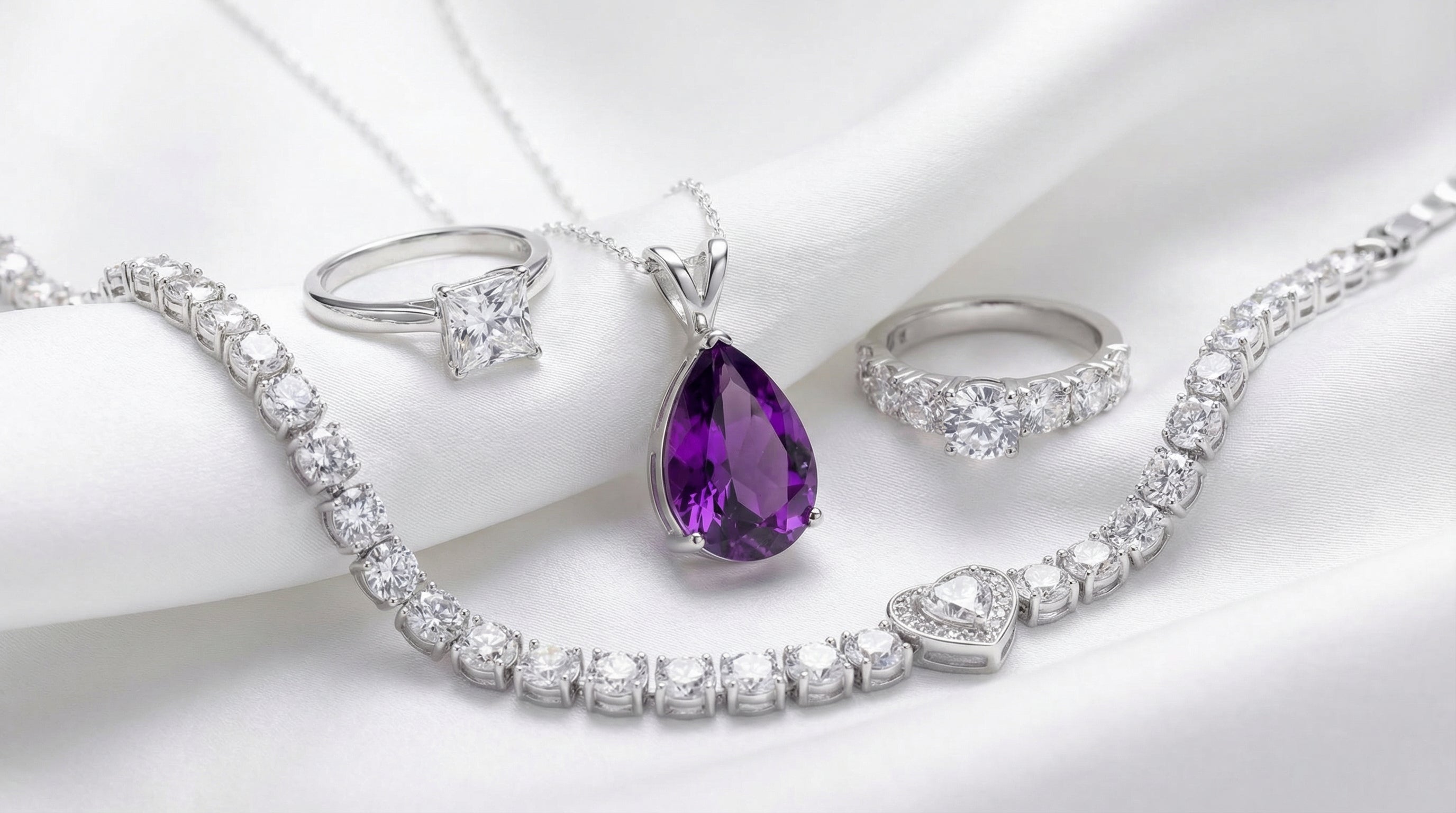
Put a moissanite tennis chain under a 10x loupe and the first thing that jumps out usually isn't an inclusion at all — it's that the facet edges look doubled, a quirk of moissanite's optical structure that diamonds don't share. That doubling is one of the most useful authenticity checks a buyer has. But it also points to something most listings gloss over: on a chain, you aren't judging one stone. You're judging a continuous row of them, sometimes a hundred or more, and the word "VVS" is being applied to every single one at once.
That changes what matters. In a solitaire, a faint cloud hides under a prong. In a 16-inch row of 3mm stones, one milky, tinted, or slightly tilted stone breaks the line and your eye finds it immediately. So a genuinely good VVS moissanite chain isn't just about clarity grade — it's about consistency, setting geometry, metal that won't quit, and a seller willing to put specifications in writing. This guide walks through each of those in the order you should evaluate them.
What "VVS" Actually Means When It's Stamped on a Chain
Moissanite is silicon carbide, and every stone on the market is lab-created. Because of that lab origin, the industry borrowed the diamond world's 4Cs framework — color, clarity, cut, carat — to describe it. On that clarity ladder, VVS (Very Very Slightly Included) sits below FL/IF (Flawless and Internally Flawless) and above VS1 and VS2 (Very Slightly Included). In practical terms, a VVS stone contains inclusions that require magnification to detect and are invisible to the naked eye.
The inclusions that exist — and why they don't hurt the stone
Inclusions formed during the growth process can include needles, mineral crystals, clouds, feathers, knots, chips, and cavities. None of these compromise durability. Moissanite ranks 9.25 on the Mohs hardness scale — second only to diamond at 10 — so a VVS stone and a VS2 stone are equally resistant to scratching. What clarity affects is visual cleanliness and price, not toughness.
Why D color and VVS clarity are usually quoted together
Clarity alone doesn't produce a bright chain. Gemological guidance for moissanite consistently points to colorless D through F color, clarity from FL to VS1, and excellent or very good cut grades for the best appearance. VVS is the aspirational middle of that clarity range: essentially perfect to the eye without paying for laboratory-verified flawlessness. If a listing advertises VVS but stays silent on color and cut, you're only getting one third of the story — a well-cut D-color VVS stone and a poorly cut, faintly tinted VVS stone look nothing alike in daylight. Our deeper breakdown of how to read moissanite grades for VVS clarity and D color covers how those grades interact.
The standardization gap you need to price in
Here's the part the category rarely admits: moissanite does not have the universal, independent grading infrastructure diamonds enjoy. Different manufacturers and retailers apply grading methodology differently, so "VVS" on a product page is a vendor claim until it's documented. That isn't a reason to avoid moissanite — it's a reason to buy from sellers who describe their stones specifically (color grade, clarity grade, cut quality, millimeter size, stone count) rather than sellers who use "VVS" as decoration.
Chain Styles: What Each Build Actually Asks of You
Tennis chains
The continuous single row of prong- or bezel-set stones is the category default, sized by stone width in millimeters, typically from around 2mm up to 8mm and beyond. Width is the single biggest driver of how the piece reads on the body. There's a manufacturing wrinkle worth knowing: micro tennis chains at roughly 2mm require roughly double the number of individual stones compared with a standard 3–4mm build, which makes them significantly harder to produce and more prone to stones flipping or drifting out of alignment during wear. If you want a micro chain, inspect the row for even stone spacing and consistent stone orientation before you commit.
Cuban links with stones
A Cuban link is a different animal — interlocking, ropey links rather than a stone-by-stone row, with moissanite set into the links themselves. That construction is heavier, more labor-intensive, and generally more expensive per inch than a comparable tennis chain, because each link is both a structural element and a setting. It's also more forgiving of daily abuse than a delicate micro row. If you're weighing that route specifically, our VVS Cuban link chain guide compares the construction details.
Monaco and cluster designs
Monaco chains combine substantial chain weight with larger stone clusters, while cluster tennis designs group several small stones into floral or starburst arrangements instead of a single line. Both maximize surface sparkle and both cost more to build, because every additional stone is another setting operation and another prong set to maintain. Judge these on prong quality, not just on flash.
Chain-and-pendant pairings
If you want a moissanite chain and pendant worn together, treat them as one system. Match metal tone and stone color grade first — a D-color pendant against faintly warm chain stones is the most common mismatch — then stagger the lengths so the pendant hangs clear of the tennis row instead of resting on it and abrading the settings. Pieces like the Heart Halo Moissanite Necklace or the Moissanite Infinity Heart Necklace work as the lower, focal layer under a plain or narrow iced chain. For pendant-led styling in particular, our moissanite pendant and chain pairing guide goes further on proportion.
Metal: The Decision That Determines Whether You Still Wear It Next Year
925 sterling silver
Sterling silver is genuine precious metal and its jewel-white tone is arguably the best backdrop for colorless moissanite, since it doesn't push warmth into the stones. Its trade-off is maintenance: silver tarnishes on contact with air, humidity, and certain chemicals. That tarnish is surface-level and reversible with polishing, and storing pieces sealed and dry stretches the interval between polishes considerably.
Gold plating and vermeil
Gold-plated chains typically apply a thin electroplated gold layer over a brass or copper base. Friction from skin, clothing, sweat, and lotions wears that layer away, and once it's gone the base metal shows through as dullness or discoloration. Even good plating degrades within months to a few years of consistent wear, after which re-plating is the only fix. That makes plating a reasonable choice for occasional or rotational wear and a poor choice for a chain you intend to wear every day. Vermeil — a heavier gold layer over sterling silver — sits between plating and solid gold, but it is still a coating with a finite life.
Solid gold
Solid gold in yellow, white, or rose doesn't fade or peel, which is why it's the default for pieces meant to last decades. The trade-off is cost: metal choice alone can double or triple the price of an otherwise identical design. If you plan to wear one chain constantly for years, the math generally favors solid gold over repeated re-plating; if you rotate through several looks, silver is the more sensible platform. Our solid gold pieces and broader fine jewelry collections show the difference in person better than any spec sheet.
What Actually Drives the Price — and Where Markup Hides
Moissanite pricing behaves differently from diamond pricing in one important way: it scales roughly with stone size rather than climbing exponentially. Going from a narrow row to a wider one increases cost proportionally, not dramatically. Practically, that means you can buy visual impact — a wider tennis chain, a larger center stone — without the cost cliff you'd hit on the diamond side of the counter.
Beyond size, four things move the number: stone quality (D color and VVS clarity carry a premium over near-colorless and VS grades), metal (solid gold substantially exceeds silver), labor intensity (cluster and multi-stone designs exceed simple linear rows), and total stone count. Brand alone should not.
How to compare two listings honestly
Write down a specification sheet before you shop: metal and purity, millimeter width, chain length, total stone count, color grade, clarity grade, clasp type, and finished weight in grams. Then compare that identical sheet across at least three established sellers. Two failure modes show up fast. The first is a premium price attached to entirely standard specifications, which is marketing markup rather than quality. The second is a price far below everyone else's, which usually signals lower grades than advertised, thin metal, or certification problems. Finished weight is the most revealing single number, because a chain marked 925 that arrives noticeably light is the most common substantiated complaint in this category. If a seller won't state grams, that's information too. For a fuller look at cost structure in iced chains, see what you're really paying for in a VVS chain.
Certificates, the "GRA" Problem, and How to Verify a Chain
This is the single highest-risk area in the moissanite market, and it deserves plain language. Certificates claiming to come from the "GRA" (Gemological Research Association) circulate widely with moissanite listings. No legitimate organization by that name exists; the acronym is a deliberate echo of the Gemological Institute of America. Jewelry authorities now treat a GRA certificate as an automatic red flag — it indicates either fraud or a seller who doesn't know what they're selling. Compounding the confusion, GIA does not typically certify moissanite in the first place, so "GIA-style" paperwork for a moissanite chain warrants scrutiny rather than reassurance.
Verifying paperwork
- Cross-check any report number directly on the issuing organization's own website; if there's no searchable database, the document proves nothing.
- Examine print quality, font consistency, and grammar — counterfeits routinely fail on all three.
- If a stone is laser-inscribed, confirm the inscription matches the number on the document.
- Prefer sellers with a verifiable address, a stated return policy, and warranty terms written out rather than implied. Established manufacturers such as Charles & Colvard, which began commercializing moissanite in 1995, issue their own certificates of authenticity with laser-inscribed identification numbers — that's the format to benchmark against.
Verifying the stones themselves
The loupe test is the most accessible check: look through the table of a stone at the opposite facet edges. Moissanite is doubly refractive, so those edges appear doubled. Diamond, being singly refractive, does not show this. Be careful with inexpensive handheld testers — basic thermal-conductivity diamond testers can read moissanite as diamond because their thermal behavior is similar. Multi-testers that also measure electrical conductivity separate the two reliably, and a gemological lab with spectroscopic equipment settles the question definitively. On a high-value purchase, a seller who welcomes independent verification is telling you something useful.
Setting and Build Quality: Where Chains Actually Fail
Stone loss on tennis chains is almost always a setting problem, not a stone problem. Quality benchmarks for prong work call for prongs retaining roughly 40–50% of their original metal thickness, prong angles in the 70–80 degree range, and prong contact covering roughly 33–50% of the crown distance. Work built below those standards shows markedly higher rates of stones falling out.
Prong, bezel, or channel
Prongs expose the most stone surface and therefore maximize light return, but they need periodic inspection and tightening. Channel settings tuck stones between metal walls for better security. Bezel settings wrap each stone in a metal rim — the most secure and snag-resistant option, and a sensible choice for anyone who wears a chain daily or works with their hands. A build like the Silver Bezel-Set Moissanite Tennis Chain trades a little raw prong sparkle for a cleaner line and considerably less anxiety about catching the row on a collar or a seatbelt.
Clasps and end links
A tennis chain's weakest point is where the row meets the clasp. Look for a clasp proportional to the chain's weight, ideally with a secondary safety catch on heavier pieces, and ask whether the end links are reinforced. Also ask directly what the seller's warranty covers — manufacturing defects, stone loss, prong retipping, replating — and what it excludes as normal wear. Vague warranty language is a legitimate reason to walk.
Width, Length, and How It Will Actually Sit
Millimeter width controls presence. Roughly 2–3mm reads as a fine, quiet line and layers well under other pieces. Around 4–5mm is the most versatile everyday range — clearly visible, still wearable under a collar. Anything from 8mm upward, including most stone-set Cuban and Monaco builds, is a deliberate statement and carries real weight on the neck, which matters over a full day.
For length: 16–18 inches sits at or just below the collarbone, 20 inches lands at the upper chest, and 22–24 inches clears most crew necklines and suits wider chains. When layering a chain and pendant, keep at least two inches of separation so the pendant swings free. Mixing one narrow and one wider chain in the same metal tone reads more intentional than two chains of identical width. If you're layering across metals, our roundup on gold chains styled with moissanite covers tone matching in more detail.
Care That Keeps a VVS Chain Looking VVS
Moissanite's hardness means the stones themselves will hold their brilliance and fire indefinitely under normal wear — this is the clearest advantage over cubic zirconia, which ranks 8.0–8.5 on the Mohs scale, is roughly a third as tough against chipping, and characteristically clouds and dulls within a few years of regular wear. What dulls a moissanite chain is film, not damage: lotion, perfume residue, and skin oils collecting behind the stones where light enters.
- Wash with warm water, a drop of mild soap, and a soft brush worked along the back of the row, then rinse and dry thoroughly.
- Apply fragrance and lotion before putting the chain on, not after.
- Store pieces separately and dry; anti-tarnish materials meaningfully slow silver tarnish.
- Have prongs checked periodically, especially on micro and cluster designs with many small settings.
One honest note on value: moissanite is a luxury purchase, not a financial instrument. Resale options are limited compared with diamonds, and the sensible way to think about it is that the savings happen at purchase rather than at resale. Buy the piece because you'll wear it for years, not because you expect to sell it.
The Pre-Checkout Checklist
- Stone specs in writing: color grade, clarity grade, cut quality, millimeter size, total stone count.
- Metal specs in writing: 925 sterling, vermeil, plating thickness, or solid gold karat — plus finished weight in grams.
- Setting type and clasp type, with a safety catch on heavier chains.
- Certification sanity check: no GRA documents; any report number must be verifiable at its source.
- Warranty and returns spelled out, including what counts as normal wear.
- Three-way price comparison against an identical spec sheet before you buy.
Frequently Asked Questions
Is VVS worth paying for over VS on a chain?
On a chain, yes more often than on a single stone. VS1 and VS2 inclusions are also eye-clean in most cases, but a long row multiplies the chance that one stone in the batch sits at the weaker end of the grade. Paying for VVS is really paying for tighter consistency across the whole row. If the budget is tight, prioritize color grade and cut quality first — those affect brightness more visibly than the step from VS1 to VVS.
Will people be able to tell it isn't a diamond?
Casual observers generally won't, but the optical signature does differ and it's worth choosing deliberately. Moissanite has a refractive index of about 2.65–2.69 versus diamond's 2.42, and a dispersion value of 0.104 versus diamond's 0.044 — more than double the ability to split light into spectral colors. The result is noticeably more rainbow fire, especially under direct sun and LED spotlighting. Some buyers specifically want that effect; others prefer diamond's more restrained white sparkle. Neither reaction is wrong. Our moissanite versus diamond comparison breaks down the optical differences side by side.
What width should I buy for everyday wear?
For a first chain worn most days, 3–5mm is the practical range. It's substantial enough to read as jewelry, light enough to forget you're wearing, and built with a stone count that's realistic to manufacture well. Save 2mm micro rows for layering and 8mm-plus builds for when you already know you like the weight.
Can I have a moissanite pendant made to my own design?
Custom pendant work is common, but the specifications need to be locked down in writing before production — stone color and clarity grade, exact carat or millimeter dimensions, metal and purity, setting type, and finished weight. Custom pieces carry higher labor cost and longer lead times, and they're harder to return, so the documentation matters more than it does on a stock piece. Ask for photos of the finished piece under both natural and indoor light before shipping.
Is a gold-plated moissanite chain a bad buy?
Not inherently — it's a mismatch of expectations. Plating is a coating with a finite lifespan that friction and body chemistry will wear through, so it suits occasional wear and rotation. If you want a gold-toned chain you'll wear daily for years, solid gold is the only finish that won't require re-plating.
A VVS moissanite chain is one of the few places in jewelry where the technical details map directly onto satisfaction: consistent D-color VVS stones, a well-executed setting, metal appropriate to how often you'll wear it, and a seller who documents all three. Get those right and the chain does exactly what you bought it to do — for a very long time.

Leave a comment
This site is protected by hCaptcha and the hCaptcha Privacy Policy and Terms of Service apply.