


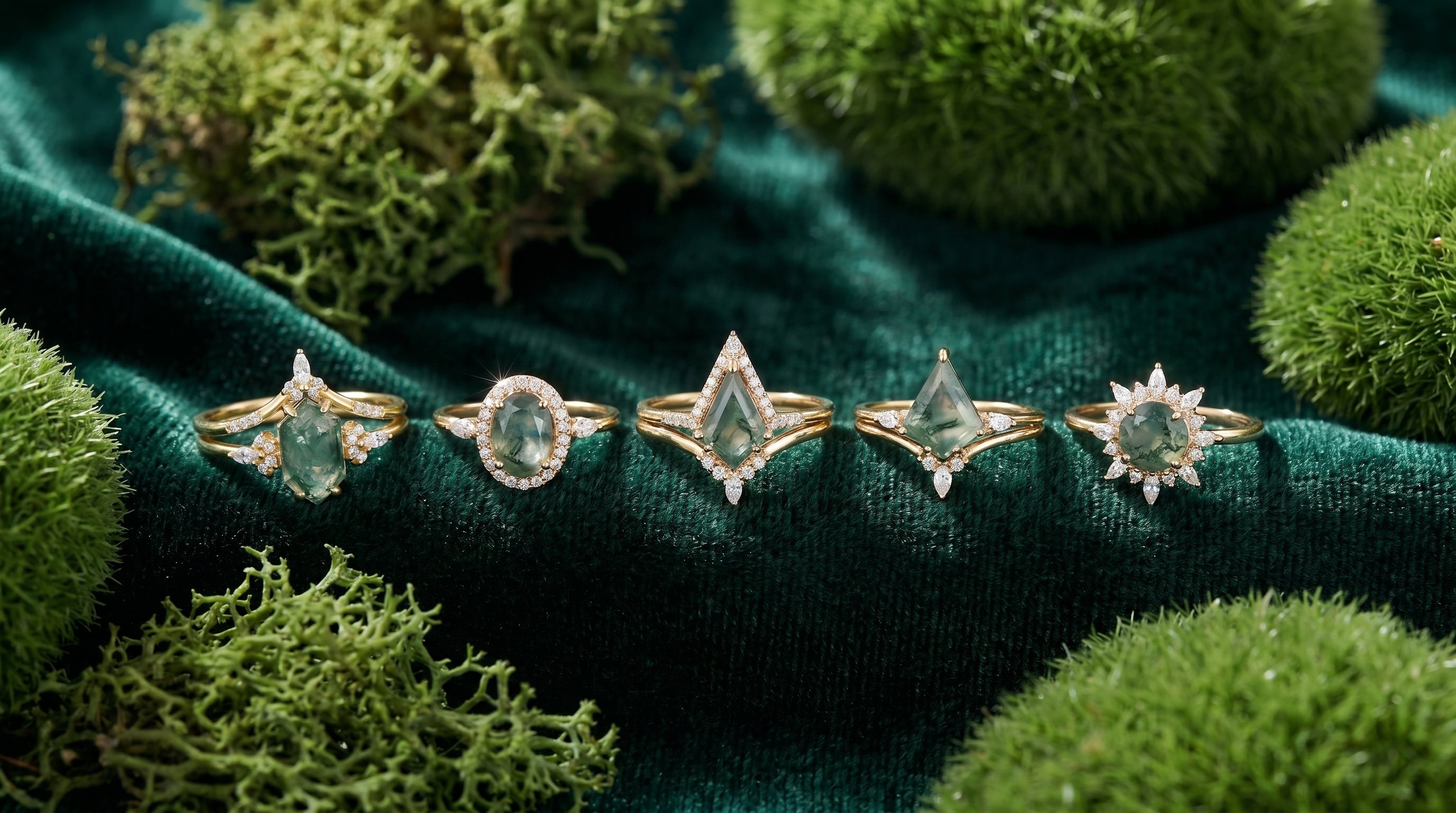
The green "moss" inside a moss agate is not plant matter at all. It is a network of dendritic mineral inclusions—largely iron and manganese oxides—that crystallized inside translucent chalcedony while the stone formed. Rose gold gets its blush from a different mineral entirely: copper, which makes up a sizeable share of the alloy (commonly in the region of 18–25% in 14k rose gold, and up to roughly 22% in 18k). Put the two together and you get an unusual visual logic: warm pink metal reading as the opposite of cool forest green, so each one makes the other look more saturated. That contrast is the real reason a rose gold moss agate engagement ring photographs so differently from the same stone in white metal, and it is why this pairing has become a signature look in nature-led bridal jewelry.
This guide is written for someone actually choosing a ring, not browsing definitions. Below you will find how cut shape changes the way dendrites read, which moss agate designs suit which hands and lifestyles, what the stone means, where gold vermeil makes sense and where solid gold is the better call, and a care routine that respects both a 6.5–7 hardness stone and a copper-rich alloy.
What Actually Makes This Combination Work
The stone: a one-of-one center
Moss agate is a variety of chalcedony, part of the wider quartz family, typically translucent to semi-transparent with those dendritic inclusions suspended inside. Unlike banded agate, which shows concentric color layers, moss agate reads as landscape: tree lines, clouds of green, occasional reddish, brown, or near-black flecks depending on the mineral mix present during formation. Body color ranges from pale sage through deep forest green.
Two practical consequences follow. First, no two stones match, so there is no diamond-style grading shorthand to lean on—you evaluate each stone individually for pattern, color intensity, and how the inclusions are distributed. Second, because the material is translucent, light travels into the stone and interacts with the inclusions, so the pattern shifts with viewing angle and lighting. A moss agate that looks flat in a dim room can look three-dimensional in daylight. If you are buying online, look at multiple images taken in different light rather than a single studio shot.
The metal: what copper adds and costs
Copper is what turns gold pink, and it brings trade-offs worth knowing before you commit. On the plus side, copper adds hardness relative to yellow gold, so a rose gold setting can hold its shape slightly better under daily knocks—useful when the stone it protects is softer than a sapphire. On the other side, copper is more prone to oxidation, which means rose gold is more susceptible to gradual tarnish and color shift when it meets moisture, sulfur compounds, or acidic substances. It responds well to cleaning; it simply asks for it more often than white or yellow gold. A small number of wearers with particular skin chemistries also notice discoloration or mild irritation from higher-copper alloys, which usually resolves with better cleaning habits or a different metal.
Karat choice matters too. 14k rose gold (58.3% pure gold) carries a higher proportion of alloy metals and is the more robust choice for a ring worn every day, while 18k (75% gold) gives a richer, deeper color with slightly less hardness and therefore a little more care required.
Moss Agate Meaning: The Symbolism Couples Are Buying Into
Stone of new beginnings
Moss agate is widely known as the "Stone of New Beginnings," which is close to a perfect brief for an engagement ring. Beyond that headline, the traditions attached to it emphasize emotional growth, patience, and the ability to weather difficult seasons—qualities that map neatly onto a long partnership. The internal pattern does a lot of the symbolic work on its own: branch-like, root-like, unmistakably organic, a visual metaphor for a relationship that grows, goes dormant, and grows again with more complexity than before.
Balance and harmony are the other recurring themes. Various traditions credit moss agate with steadying emotional fluctuations and encouraging calm resolution of conflict, and in chakra-based systems it is associated with the heart center, which governs love, compassion, and connection. That is the core of moss agate's spiritual meaning where love is concerned: not passion at first sight, but grounded, patient attachment. For couples who care about environmental consciousness or simply want something drawn from the natural world rather than a marketing campaign, the nature association is itself part of the appeal.
A longer history than most people expect
Moss agate is not a recent invention of alternative bridal. Neolithic peoples worked it into amulets and beads, associating the moss-like inclusions with the natural world and agricultural fertility. In ancient Greek and Roman contexts it was tied to agriculture and harvest, carried by farmers hoping for good crops and protection from disaster. Medieval healers used it in the belief it restored physical and emotional balance, a thread that survives in modern crystal practice. The Victorian appetite for sentimental jewelry brought it back for engagement and commitment rings, and the Arts and Crafts movement of the late 19th and early 20th centuries elevated it further, since its natural variation suited a philosophy that celebrated handcraft and imperfection. If you like the idea of a vintage moss agate engagement ring aesthetic—milgrain, cluster work, fine metal detail—that lineage is real, not invented.
Cut and Setting: How Shape Changes the Look
Because moss agate's beauty is pattern rather than sparkle, the cut's job is different from a diamond's. You are framing a picture, not maximizing light return. Geometric shapes have become popular partly for that reason and partly because faceted edges and structured frames add integrity to a moderately hard stone.
Kite
The most graphic option. A kite sits diagonally across the finger, elongates the hand, and gives the dendrites a long axis to spread along—good if your stone has strong directional "tree line" patterning. It reads modern and deliberately unconventional.
Hexagon
A softer geometric. Six sides give the stone an architectural frame while keeping the silhouette compact and symmetrical, which suits shorter fingers and stacks cleanly with a straight wedding band.
Oval and marquise
Curved shapes flatter the organic pattern by removing hard corners, and both lengthen the finger. Marquise adds points, which need a protective setting, so check how the tips are held. Oval works especially well with a halo, where small accent stones sharpen the outline and add scale to the center.
Trillion
Triangular cuts are the boldest of the group and pair naturally with pyramid or chevron metalwork. They suit anyone who wants the ring itself—not just the stone—to be the statement.
Whatever the shape, prioritize setting security. Bezel and semi-bezel settings protect the stone's edges far better than open prongs, and because the dendritic structure creates natural planes of weakness, side impacts—not surface scratches—are what cause chips. If your work is hands-on, favor the more enclosed setting even if you love the look of high prongs.
The Roundup: Moss Agate Designs to Compare
Each design below is finished in 18K gold vermeil over an S925 sterling silver base, which is a thick electroplated gold layer rather than solid gold throughout—see the metal section that follows for what that means in practice. Because moss agate is unique stone to stone, treat these as design templates and evaluate the specific stone shown on each listing. Rose gold devotees should confirm the exact finish offered on the product page before ordering.
Hexagon ring set
The Natural Moss Agate Hexagon Ring Set pairs a hexagonal center with a matching band, so the engagement ring and moss agate wedding ring are designed to sit flush from day one. Choose this if you want geometry without drama and you would rather buy the pair together than hunt for a band later.
Halo oval with pavé
The Natural Moss Agate Halo Oval Ring surrounds an oval center with a pavé halo and shoulders. The halo does two useful things: it visually enlarges the center and it gives the eye a bright border that makes green dendrites look deeper. This is the closest style here to a traditional engagement ring silhouette, which helps if one of you wants classic and the other wants unusual.
Kite cut with geometric frame
The Natural Moss Agate Kite Cut Geometric Ring Set adds an outlined frame around the kite, giving an Art Deco–adjacent structure and extra protection at the points. A strong pick for anyone drawn to architectural design or wanting the stone to look intentionally set rather than simply mounted.
Kite cut, clean setting
If you prefer the same diagonal silhouette without the surrounding frame, the Kite Cut Natural Moss Agate Ring Set keeps the metalwork minimal so the pattern carries the ring. Minimalist settings also make the stone easier to clean, since there are fewer crevices for debris.
Marquise sunburst
The Natural Moss Agate Sunburst Ring sets an elongated marquise within radiating metalwork. It is the most decorative solo ring in the group and works well worn alone, which suits anyone who prefers one meaningful ring to a stack.
Trillion bridal set
The Natural Moss Agate Trillion Cut Bridal Ring Set builds a pyramid-style profile around a triangular stone with accent stones for contrast, supplied as a coordinated set. Best for a wearer who wants an obviously non-traditional ring and a band engineered to fit it.
If rose gold matters more than moss agate
Some shoppers arrive at this search because of the metal, not the stone. If the pink tone is the non-negotiable and you are open on the center, The Luna – Rose Gold shows how a warm rose finish reads on the hand with a bright center stone instead of a patterned one. Moissanite is also the accent stone of choice in many moss agate designs precisely because it is lab-created, durable, and visually bright next to a softer, quieter center.
For a wider look at the category, our moss agate engagement ring set comparison covers matched pairs in more depth, and the full moss agate rings collection shows current stones as they come in.
Gold Vermeil vs. Solid Gold: Making the Call Honestly
Gold vermeil is a thick layer of gold—typically 10k or higher, plated at 2.5 microns or more—bonded over a base metal, usually sterling silver. Visually it can be very close to solid gold, and it brings a rose gold or yellow gold look within reach for shoppers who want a distinctive design without solid-gold pricing. The honest trade-off is that plating is finite. High-contact areas, especially the inside of a band, will eventually wear through with regular use, revealing the base metal beneath. Quality vermeil can look excellent for years with careful handling, but it will not behave like solid metal indefinitely.
Three practical points follow from that:
- Resizing and repair are harder. Work on a vermeil ring generally means the plating in the affected area is removed and reapplied, which may not match the original finish perfectly. Get your size right at the outset—measure at the end of the day, at normal room temperature, and size the band width you actually intend to wear.
- Care is stricter. Keep vermeil away from water where you reasonably can, along with soap, perfume, lotion, harsh chemicals, and abrasive cleaning.
- Value retention differs. Solid gold holds intrinsic metal value and its composition indefinitely with proper care, which is why it is the better choice for a piece intended as an heirloom to pass down.
There is also a compounding effect worth naming: moss agate has its own care requirements, so pairing it with vermeil means two maintenance-sensitive materials in one ring. If you want the lowest-maintenance version of this look, a solid gold setting is the sensible upgrade—see our solid gold pieces. If you would rather have a more elaborate design now and accept periodic refinishing, vermeil is a legitimate, clear-eyed choice rather than a compromise you have to apologize for.
Durability and Care for a Copper-Rich Metal and a 6.5–7 Stone
What the hardness number really means
Moss agate sits at roughly 6.5–7 on the Mohs scale—slightly harder than a steel nail, between amethyst and topaz, and well below sapphire at 9 or diamond at 10. Gemological classifications describe its wearability as good to excellent when it is properly set and cared for. In plain terms: it is genuinely wearable every day, and it will not tolerate the same abuse a diamond shrugs off. Surface scratching from harder materials is the everyday risk; chipping from a side impact is the serious one, which is why setting style matters more here than in a diamond ring.
When to take the ring off
Remove it for household cleaning (abrasives and chemicals), gardening (impact plus soil acids), and workouts (impact, plus sweat and lotions that dull the finish). Take it off for swimming and long baths—water accelerates tarnish on copper-rich rose gold and is unkind to plating. Avoid sudden temperature swings, such as going from cold outdoors straight into a sauna, since thermal shock can crack the stone. Store it away from diamonds and sapphires, which will scratch moss agate on contact, ideally in a fabric-lined box with dividers or its own pouch.
The cleaning routine
Use lukewarm water and a mild, pH-neutral soap. Nothing strongly acidic or alkaline: it can dull the stone's luster and hurry tarnish along on the metal. Work gently with a very soft-bristled brush around the stone and any detailed metalwork, rinse thoroughly in lukewarm water to remove every trace of soap, and dry with a microfiber or lint-free cloth rather than a towel that can abrade the surface or shed fibers into crevices. Skip commercial cleaners formulated for diamonds and harder stones. Approach ultrasonic cleaners with real caution—only devices calibrated for softer gemstones, only briefly, and only for genuinely embedded grime.
Longer-term upkeep
Book a professional clean and inspection annually, or every six to twelve months if you wear the ring constantly. A jeweler can steam clean safely, check that prongs or bezels are still secure, and flag any developing issues in the setting. Periodic professional re-polishing can restore the stone's original sheen after years of micro-scratching. Genuine natural moss agate resists fading in normal conditions, though leaving it in intense direct sunlight for very long stretches may, rarely, reduce vibrancy over many years. Photographing the ring when new gives you a useful reference point for judging wear later. For more on caring for the material across ring, necklace, and earring formats, see our complete guide to moss agate jewelry.
How to Choose Yours
Work through these in order and the decision usually resolves itself:
- Judge the individual stone, not the style. Since grading systems do not apply, ask yourself whether the pattern in that specific stone means something to you—a tree line, a coastline, a shape you recognize. That is the whole point of the material.
- Match setting to lifestyle. Hands-on work, an active routine, or a tendency to knock things means bezel or framed settings, not high open prongs or unprotected marquise points.
- Decide metal by time horizon. Wearing it for decades and passing it on argues for solid gold. Wanting a more elaborate design and accepting periodic refinishing makes vermeil reasonable.
- Buy the band with the ring where possible. Matched sets remove the guesswork of finding a wedding band that sits flush against a geometric or curved outline later.
- Get sizing right the first time. Especially with plated metals, where resizing means refinishing.
Frequently Asked Questions
Is moss agate durable enough for an engagement ring?
Yes, with informed expectations. At 6.5–7 on the Mohs scale it is classed as having good to excellent wearability when properly set and maintained, and it is hard enough for open, traditional-style settings that show the stone. It is not as forgiving as a diamond or sapphire, so protective settings and the removal habits above make a measurable difference.
Does rose gold tarnish?
Its copper content makes it more prone to oxidation and gradual color change than yellow or white gold, particularly with exposure to moisture, sulfur compounds, and acidic substances. Regular gentle cleaning and dry storage keep it looking as intended; expect to clean a rose gold ring a little more often than a white gold one.
Can the same design work as a wedding or promise ring?
It can. Moss agate's association with new beginnings and steady growth reads just as well on a moss agate promise ring or a wedding band as on an engagement ring, and the matched sets above are built so the two pieces sit together. Many couples use a plainer band alongside a patterned center so the stone stays the focal point.
What if I want a diamond-style sparkle alongside the stone?
Halo and pavé designs answer this, and moissanite is the usual accent choice—lab-created, durable, and bright next to a translucent center. If sparkle turns out to matter more than pattern, our moissanite engagement rings cover that end of the spectrum.
Are two moss agate rings ever identical?
No. Every stone's dendritic pattern is unique, which is the strongest argument for buying the exact stone you have seen photographed rather than a stock representation of the style. For a broader walkthrough of the category before you commit, our complete moss agate engagement ring buyer's guide goes deeper on sourcing and stone selection.

Leave a comment
This site is protected by hCaptcha and the hCaptcha Privacy Policy and Terms of Service apply.