


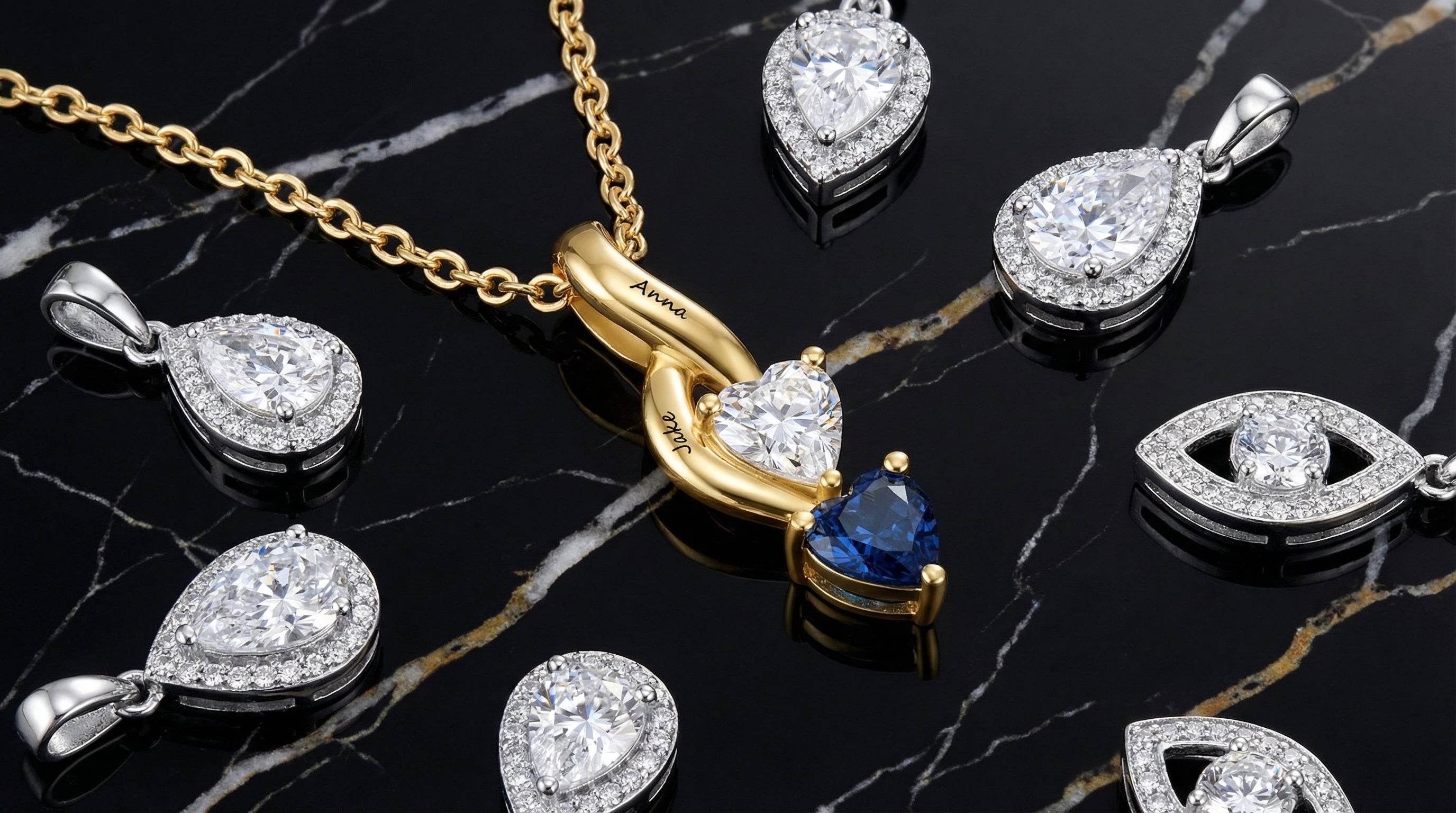
A 6.5 mm round moissanite weighs roughly 0.83 to 0.85 carats, yet it spans the same face-up diameter as a 1.00-carat round diamond. That one conversion is behind a large share of custom pendant disappointment: buyers order by carat weight, receive a stone that is dimensionally correct but numerically "smaller," and assume something went wrong. Nothing did. Moissanite is less dense than diamond, so weight and visible size stop tracking each other the moment you cross between the two materials.
Commissioning a VVS moissanite custom pendant is really an exercise in writing a good specification. Unlike buying a finished piece off a product page, you are the one deciding stone dimensions, clarity and color grades, cut, setting style, metal, bail, and chain, and any single vague instruction shows up in the finished piece. This guide walks through each of those decisions in the order a jeweler will ask about them, flags the documentation you should insist on, and explains what genuinely changes the way the pendant looks around your neck.
What VVS Actually Means on a Moissanite Pendant
VVS stands for Very, Very Slightly Included. Moissanite clarity follows the grading conventions established by the Gemological Institute of America for gemstones, running from Flawless and Internally Flawless at the top, through VVS1 and VVS2, and down into progressively more included grades. A VVS stone shows only the most minute internal characteristics under 10x magnification, and those characteristics have no appreciable effect on how the stone handles light or on its structural integrity.
Two practical points follow from this. First, VVS inclusions are invisible without a loupe, so during normal wear a VVS moissanite is indistinguishable from a flawless one. Second, because laboratory growth allows tighter quality control than geological formation, VVS is the clarity tier that quality-focused moissanite sellers work in as a matter of course rather than as a rare find. That is why "VVS" is more useful to you as a documented, verifiable specification than as a visual promise.
Clarity does not affect durability
A common misreading is that a higher clarity grade means a tougher stone. It does not. Clarity describes internal characteristics; hardness and toughness are properties of the material itself. A VVS moissanite and a lower-clarity moissanite of the same cut are equally hard. What VVS clarity does protect is optical performance: with essentially nothing inside the stone to interrupt light, the full refractive potential of the material reaches your eye.
Clarity and color are separate axes
You can specify VVS clarity in a colorless D, E, or F stone or in a near-colorless G, H, or I stone. Clarity does not constrain color, and vice versa. Deciding them independently, rather than assuming one implies the other, is the single fastest way to avoid overpaying for a grade you cannot see while underspending on one you can. Our deeper breakdown of how to read moissanite clarity and color grades covers the scales in detail.
The Six Specs That Define Your Custom Pendant
1. Specify millimeters, not carats
Always brief the stone in millimeters and, if relevant, ask for the "diamond equivalent weight" as a secondary note. Millimeter dimensions describe what a viewer actually sees; carat weight describes mass. For a pendant this matters twice over, because stone dimensions dictate the proportions of everything built around them: the halo diameter, the bail scale, the overall drop length, and how the piece reads against a collarbone or a shirt collar. Ask for length and width on fancy shapes (an oval, pear, or marquise can be cut long and slim or short and wide at identical carat weights) and for total pendant dimensions including the bail.
2. Color grade, chosen alongside the metal
Moissanite color follows the D-to-Z scale, where D is completely colorless and Z shows light yellow. D, E, and F are the colorless grades that most closely echo the icy look of very high-quality diamonds; G, H, and I are near-colorless. Side by side, the difference between DEF and GHI is subtle to the unaided eye and generally becomes noticeable only in larger stones or at specific lighting angles.
Metal is the variable that decides which choice looks right. Colorless DEF stones set in white gold, platinum, or sterling silver reinforce that bright, icy appearance because nothing warm reflects back into the stone. Near-colorless GHI stones pair naturally with yellow or rose gold, where faint warm undertones read as harmony with the metal rather than as a flaw. Choose color grade and metal in the same conversation, not in sequence. Moissanite color also comes from the material's own composition rather than a coating or treatment, so it will not fade or shift over the life of the pendant.
3. Cut and shape
Cut is where moissanite earns its reputation. The material has a refractive index of roughly 2.65 to 2.69 against diamond's 2.42, so it bends and returns slightly more light, and its dispersion measures 0.104 against diamond's 0.044, more than double the rainbow fire. In a pendant that difference is amplified by movement: the stone swings and rotates as you walk, so flashes register more often than they do in a ring resting on a hand.
Moissanite is also doubly refractive, meaning light entering the stone splits into two rays traveling at slightly different velocities. In larger stones, one visible consequence is faint doubling of facet edges when you look through the stone at an angle. This is a normal property of the material and part of what distinguishes it gemologically from diamond, not a cutting defect. If you want maximum fire, elongated shapes and larger table areas give you more surface for those flashes; if you prefer a quieter look, a well-proportioned round in a smaller millimeter size dials the effect back. Readers weighing the material against mined stones can compare the properties directly in our moissanite versus diamond comparison.
4. Metal and karat
Sterling silver (925) is the most accessible precious metal option and gives a bright white surround that flatters colorless stones. Ten-karat gold contains less pure gold, which makes the alloy harder and a sensible pick for pendants that will be worn constantly. Fourteen-karat gold, at 58.3 percent pure gold, is the contemporary balance point between precious metal content and everyday durability. Eighteen-karat gold at 75 percent purity and platinum sit at the top of the range for buyers prioritizing metal purity or a specific density and color.
The trade-off to understand is that higher karat gold is richer in color and softer in the hand, while lower karat gold and sterling silver are harder but different in tone. For a pendant that spends most of its time hanging free rather than knocking against desks and door handles, that hardness gap matters less than it does for a ring, which is why pendants are a reasonable place to indulge a higher karat if the color is what you want.
5. Setting style
Prong settings expose the most stone surface and let light enter from the sides, maximizing brilliance. Bezel settings wrap the girdle in metal, which protects the edge and suits an active wearer or a piece that will be layered against other chains. Halos of small stones around the center make the focal stone read larger; a hidden halo, set beneath the center stone rather than around it, adds sparkle from underneath while keeping the outline clean. Ask specifically how many prongs, whether the gallery is open (which lets light through from behind and keeps the piece from looking heavy), and how the halo stones are secured.
6. The bail and chain, specified as one system
The bail is the part most often left to the jeweler's discretion and the part most likely to annoy you later. Check three things before approving a design. Does the bail's interior opening comfortably clear the chain width you intend to wear, including any future upgrade? Is the bail positioned so the pendant hangs flat rather than twisting forward, which matters most on wide pear and marquise shapes? And is the chain gauge proportionate to the pendant's weight, so a substantial center stone does not sit on a link that looks visually thin? If you plan to swap chains seasonally, ask for a slightly generous bail opening. For chain construction, link styles, and gauge guidance, see our VVS moissanite chain buying guide.
Custom Design Directions Worth Briefing
Customization is the reason to commission rather than buy finished, so it is worth arriving with a clear direction instead of asking a jeweler to guess.
Name and initial pendants
A moissanite name pendant can carry stones in two ways: pavé-set along the letterforms, or as a single accent stone anchoring one letter or the baseline. Script lettering is more fragile than block lettering at small sizes, so ask about the metal thickness behind thin strokes and whether the letters are connected continuously or joined at discrete points. Initial pendants concentrate the same idea into a single character and tolerate a larger focal stone.
Symbols, motifs, and meaningful accents
Religious symbols, nature motifs such as leaves and florals, geometric abstractions, and vintage-leaning treatments like filigree and milgrain all translate well to moissanite because the stone's fire holds attention even inside a busy design. Colored moissanite in soft champagne, teal, or yellow tones is another route if you want the piece to be recognizably its own gemstone rather than a diamond stand-in. Personal markers work the same way: a piece such as the Heart-Cut Birthstone Infinity Necklace shows how a symbolic form plus a personal stone choice can carry meaning without additional engraving.
Minimalist solitaires versus statement pieces
A solitaire on a fine chain layers easily and reads as everyday jewelry. A statement pendant with an oversized center stone and elaborate metalwork does the opposite and works best as the only piece at the neckline. Decide which job the pendant is doing before you choose stone dimensions, because a stone sized for a statement piece rarely layers comfortably. If you are commissioning for a man or want a broader, heavier proportion, our men's moissanite pendant guide covers scale and chain pairing.
Certification, Authentication, and Red Flags
Three grading laboratories carry the most weight in this space. The Gemological Institute of America, founded in 1931 and headquartered in Carlsbad, California, created the 4Cs framework that underpins how clarity and color are described. The American Gem Society, founded in 1934, is particularly recognized for its precision cut grading. The International Gemological Institute, founded in 1975 and headquartered in Antwerp, has become the leading certifier for lab-created stones and grades them against criteria calibrated to synthetic material.
Independent documentation is not a formality. The GIA has documented cases of moissanite bearing fraudulent GIA inscriptions, deliberately intended to pass the stones off as natural diamonds. That is precisely why paperwork should come from a recognized laboratory or, at minimum, from a certificate of authenticity that states specific measurable attributes rather than vague marketing language.
What the paperwork should actually say
- Clarity grade stated explicitly (VVS1 or VVS2, not just "VVS quality")
- Color grade on the D-to-Z scale, not a range like "DEF/GHI"
- Millimeter measurements, plus diamond equivalent weight if quoted
- Cut and shape description
- Metal type and karat or purity mark for the finished setting
Keep that document. It substantiates insurance claims, supports any warranty claim the seller offers, and is the only reliable way to verify later that the stone delivered matches the stone ordered. Treat these as red flags: "VVS" used as a marketing adjective with no accompanying grading document; a refusal to state millimeter dimensions; no clarity on whether a quoted carat figure is actual weight or diamond equivalent weight; and warranty language that is described verbally but never written down.
Where to Spend and Where to Hold Back
Because moissanite costs a fraction of a comparable diamond, the budget pressure in a custom pendant shifts away from the center stone and toward everything around it. That changes the optimal allocation.
Spend on millimeter size and cut quality, because those are the two variables a viewer perceives from across a room. Spend on the setting and bail engineering, because that is what determines whether the pendant hangs correctly and survives years of wear. Spend on the metal if the color of the metal is central to the look you want.
Hold back on chasing D color if the pendant is being set in yellow or rose gold, where a near-colorless grade will look more cohesive anyway. Hold back on halo complexity if you are already using a large center stone, since additional small stones can compete with rather than support the focal point. And be realistic about clarity: since VVS is invisible without magnification, its value is in documented consistency, not in a visual upgrade over the next grade down.
Four Mistakes That Recur in Custom Pendant Orders
Ordering by carat weight out of habit
Decades of diamond marketing trained buyers to treat carat weight as the headline number. Carried into moissanite, that habit produces stones that are correctly specified on paper and smaller than expected in person. Convert to millimeters at the start of the conversation and stay there.
Ignoring color grade, then expecting diamond colorlessness
Selecting a near-colorless grade while mentally picturing an icy D-color stone is a reliable route to regret, particularly under warm indoor lighting. If diamond-like colorlessness is your priority, specify DEF and pair it with a white metal. If value and warmth are your priority, specify GHI and pair it with gold.
Skipping documentation on a bespoke order
Custom work makes verification harder, not easier, because there is no comparable product page to check against. Confirm before production what documentation will ship with the finished piece and what it will state.
Assuming zero maintenance
Moissanite does not cloud from within, and its color does not fade. What does happen is that skin oils, lotion, and everyday residue build a film across the pavilion, and that film reduces the light returning to your eye. Owners who mistake that film for stone degradation conclude, wrongly, that the material failed.
Care and Long-Term Durability
Moissanite ranks 9.25 on the Mohs hardness scale, just below diamond at 10, which puts it well above the 7.5 to 9 range of sapphire, ruby, and emerald. In practice that means everyday contact with clothing, hands, and surfaces does not accumulate the micro-scratching that dulls softer stones. Moissanite also lacks the cleavage planes that make diamond vulnerable to splitting under a sharp impact, so its strength is more uniform throughout the crystal, which is a genuine advantage for a pendant that occasionally knocks against a seatbelt buckle or a countertop.
This is also the clearest line between moissanite and cubic zirconia, which rates 8.0 to 8.5 on the Mohs scale. Cubic zirconia typically holds up for two to five years of regular wear before accumulated surface scratching visibly degrades its clarity, whereas moissanite's optical performance is stable over decades of normal wear. Lab creation alone is not what separates them; hardness and optical permanence are.
A cleaning routine that keeps fire visible
Warm water, a drop of mild soap, and a soft-bristled brush along the underside of the stone and around the prongs, every week or two, is enough to keep light moving through the pavilion. Rinse thoroughly and dry with a lint-free cloth. An annual professional cleaning is worth booking for pieces with halos, pavé, or filigree, where residue collects in places a home brush cannot reach, and it doubles as a chance for a jeweler to check prong tension and the bail for wear.
Pre-Order Checklist
- Stone dimensions confirmed in millimeters, with length and width on fancy shapes
- Clarity grade written as VVS1 or VVS2, with documentation promised
- Color grade chosen deliberately against the metal color
- Metal type and karat or purity specified for setting, bail, and chain
- Setting style agreed, including prong count and whether the gallery is open
- Bail interior opening checked against your intended chain width
- Total pendant dimensions including bail, plus finished chain length
- Design approval step confirmed: renders, photos, or a video review before shipping
- Production timeline and return or adjustment policy in writing
A custom pendant is one of the few jewelry purchases where the buyer's brief has more influence on the outcome than the price paid. Get the millimeters, the color-to-metal pairing, and the bail right, and a VVS moissanite center stone will do exactly what its refractive index and dispersion promise. If you would rather start from a finished design and adapt from there, browsing an existing moissanite jewelry range is a useful way to calibrate proportions before you commission anything.

Leave a comment
This site is protected by hCaptcha and the hCaptcha Privacy Policy and Terms of Service apply.